
About 1.6 billion people on Earth don’t have decent housing. The UN figures that number hits 3 billion by 2030 — 40% of humanity — and to house them all we’d need to build 96,000 new homes every single day. We are not building 96,000 homes a day. We’re not anywhere close, because we still build houses the way we did two centuries ago: a crew of increasingly hard-to-find humans standing in the weather, cutting sticks of wood and nailing them together one at a time. Construction is one of the only industries on Earth where productivity hasn’t budged in fifty years.
Meanwhile, humanity buys about a million plastic bottles per minute. Recycling was supposed to deal with this, but mostly doesn’t, because by the time you’ve collected, sorted, and washed the stuff, virgin plastic is cheaper. The bottles pile up in landfills and rivers. So we have two colossal problems sitting next to each other: a world that desperately needs cheap durable building material, and a world drowning in a free one.

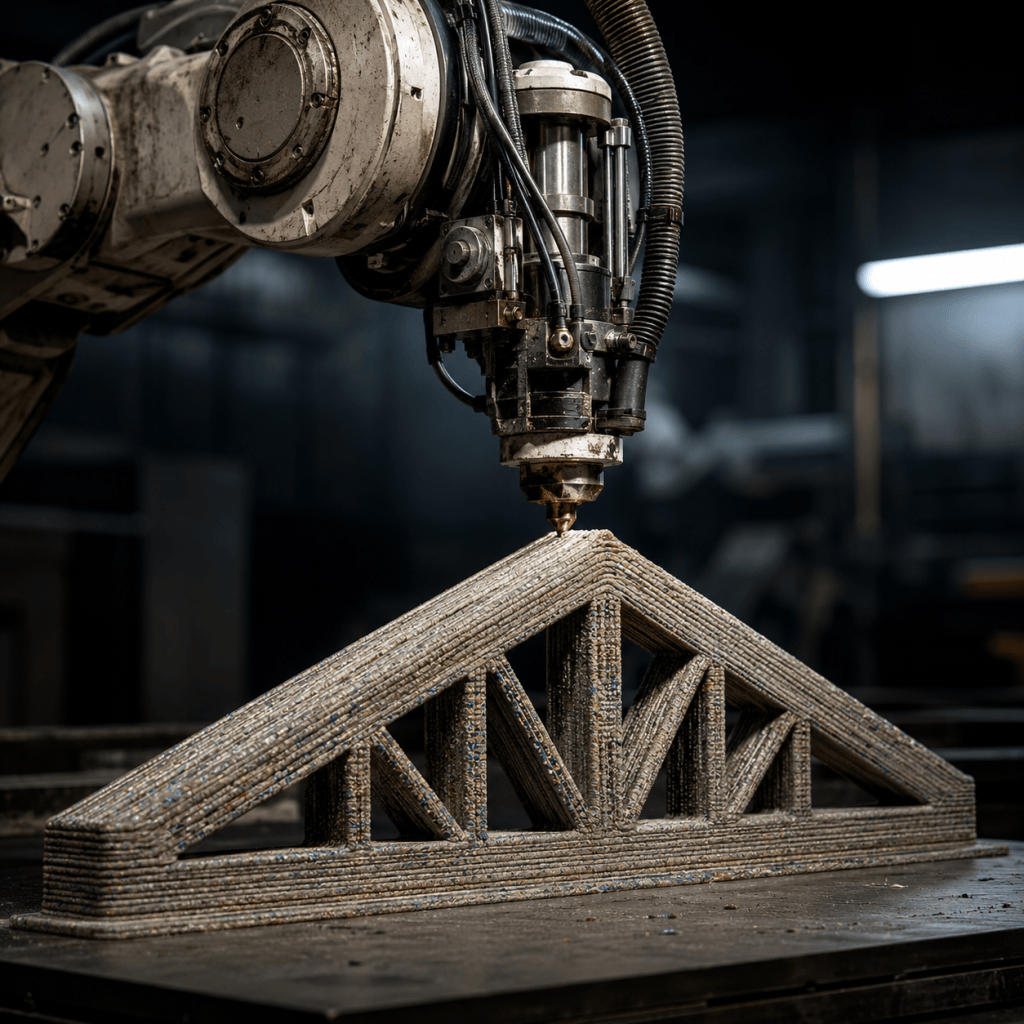
ATLAS connects them. The technology comes out of seven years of R&D at MIT: robotic AI factories that turn waste plastic into structural framing — foundation footings, wall framing, trusses, stairs — printed as precision parts that one or two people can assemble like IKEA furniture. The trick that makes the economics work is that their process takes dirty plastic. No washing, no water permits, no expensive sorting — bottles go in at pennies per pound. MIT testing shows the recycled PET parts holding 60,000 pounds per square foot, and the pilot installations have been sitting outside through New England winters for three years without complaint. A single production line costs about as much as one Bay Area down payment and prints the frame of a small house every day. Build cost cut in half. Time on the job site drops 85%.
The whole factory is designed to be exported — a self-contained microfactory you can drop anywhere on Earth, feed with local trash, and operate with local labor. The plan is to franchise them out regionally, like Coca-Cola bottlers, which is fitting, because the feedstock is Coca-Cola bottles. The first goal: 1,000 homes printed from waste Coke bottles. A small house’s frame eats tens of thousands of them. Multiply by a thousand and entire landfills start turning into neighborhoods.
The founders are an unusual pair and exactly right for this. AJ Perez is a 3x-MIT-degree deep tech founder who’s already built and sold two manufacturing companies, and personally accounted for more than 1% of MIT’s patent applications in 2024. Matt Pouliot spent twelve years in the Maine Legislature working on housing policy while running a real estate firm that’s moved over $200M in property — he’s seen exactly how the housing shortage happens, from both ends. They’re smart enough not to start in the US, where innovating in construction means convincing 9,000 counties with 9,000 building codes; the early deployments go where the housing need is desperate and the regulators are motivated.
This is the second company in our portfolio attacking how homes get built, because I think it’s one of the most important and most neglected problems in the world. Feed trash to the robots, get houses out. That’s the deep future we are building.