

Bananas for Batteries.
You’ve read about a hundred miracle battery breakthroughs — we haven’t invested in any of them — you can’t buy any of them. Any new chemistry needing new factories is dead on arrival — nobody is going to rebuild a trillion dollars of manufacturing infrastructure to try out a clever new molecule. This is why the world is drunk on lithium.
The batteries you can actually buy — in your phone, your laptop, your car, your toothbrush — nearly all trace back to one man: John Goodenough, the electrochemist whose lab invented the lithium cobalt oxide cathode in 1980. Sony commercialized it, and the lithium age began.
Goodenough didn’t stop. His lab spent the next four decades methodically deleting problem elements from the periodic table of batteries. In 1984, his lithium manganese oxide cathode got rid of most of the cobalt. In 1997, his lithium iron phosphate cathode — LFP, the chemistry inside Teslas and BYDs — eliminated cobalt and nickel entirely. He was engineering critical minerals out of batteries decades before ”critical minerals” became a Washington buzzword. The final act was going after lithium itself: his lab’s sodium Prussian White cathode in 2013 became the foundation of CATL’s sodium-ion program, and in 2017 a researcher in his lab named Leigang Xue invented Potassium Prussian White — a high-energy cathode with no lithium, no cobalt, no nickel, no copper. The reviewers called it ”a significant breakthrough for the battery field.“ Goodenough himself rated its promise on par with LFP and LCO — his own inventions. Two years later he won the Nobel Prize. One lab in Austin invented the cathode in basically every battery you’ve ever owned, and then invented its successor.
Lithium is scarce, miserable to refine, and the supply chain — lithium, cobalt, nickel — runs overwhelmingly through China. Lithium cells also have a well-earned reputation for catching fire, which gets exciting when you stack a few thousand of them in a building full of expensive computers.
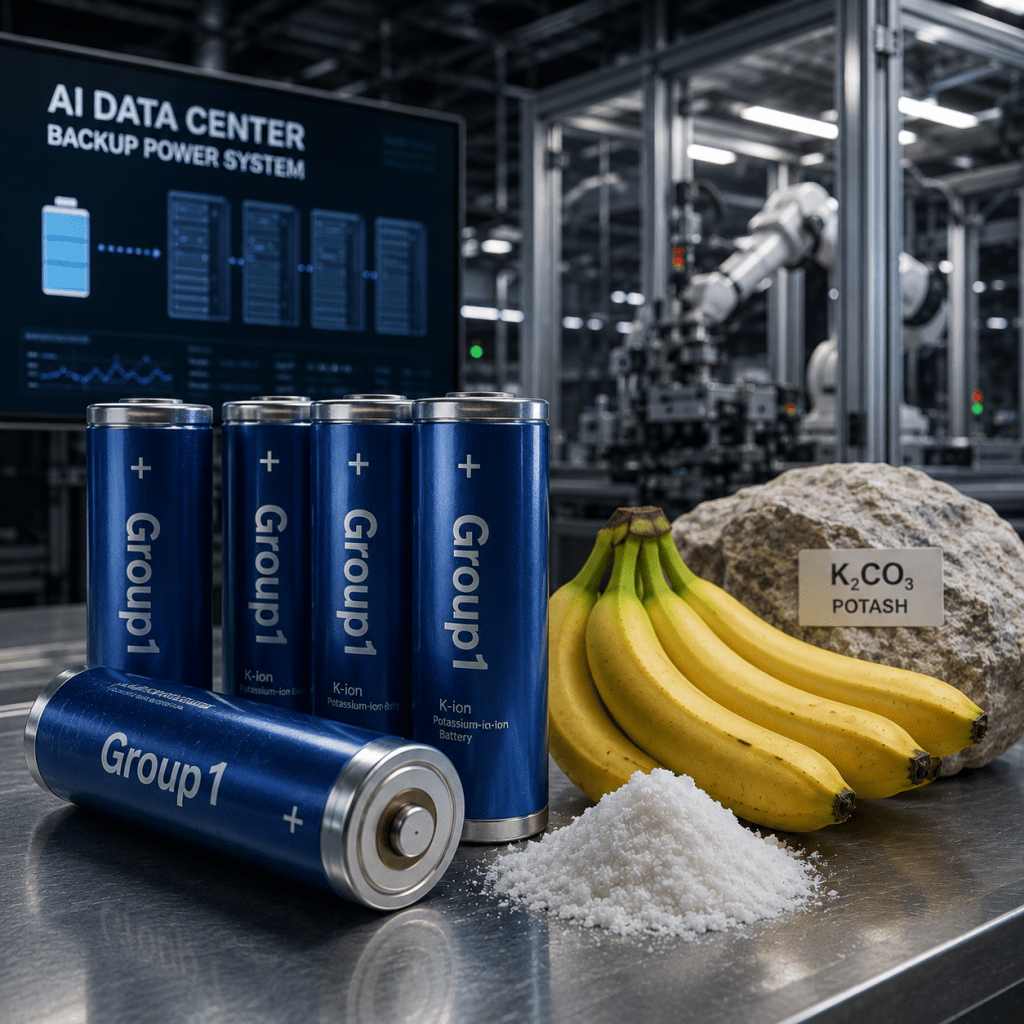
Group1 was founded to commercialize Xue’s invention, with Xue as co-founder. Potassium is about a thousand times more abundant than lithium. It’s potash — fertilizer — farmers buy trainloads of it. You ate some at breakfast; there’s half a gram in every banana. Nobody controls the supply because it’s everywhere, including a massive deposit in Michigan that the Department of Energy is backing with $1.26 billion to mine.
Group1’s potassium cells are made on existing lithium-ion production lines. Potassium slides into the same graphite anodes lithium uses — a trick sodium can’t pull off, which is why sodium-ion needs new factories and potassium doesn’t. Same slurry mixing, same coating, same assembly, same machines. No retooling. Group1 built the world’s first potassium-ion 18650 — same size and voltage as the lithium cell in a Tesla — and has already produced them on the commercial production lines of one of the biggest battery manufacturers on Earth. The trillion-dollar moat is their trillion-dollar head start.
The first customers are AI data centers. Every data center keeps a wall of backup batteries standing by for the moment the grid hiccups — power failures cost the industry about $20 billion a year. Today that wall is either lead-acid, a chemistry from 1859, or lithium cells wrapped in fire suppression. Potassium cells deliver huge bursts of power on demand, which is exactly what backup requires, without the fire anxiety and without a supply chain that routes through a geopolitical rival. Group1 is even closing the loop with the Michigan potash mine: their batteries will provide backup power for the facility that digs their feedstock out of the ground. American potassium, American cells, powering American infrastructure.
Goodenough spent forty years removing every troublesome element from the battery, and lithium was the last one left. We invested so Group1 can finish the job.