
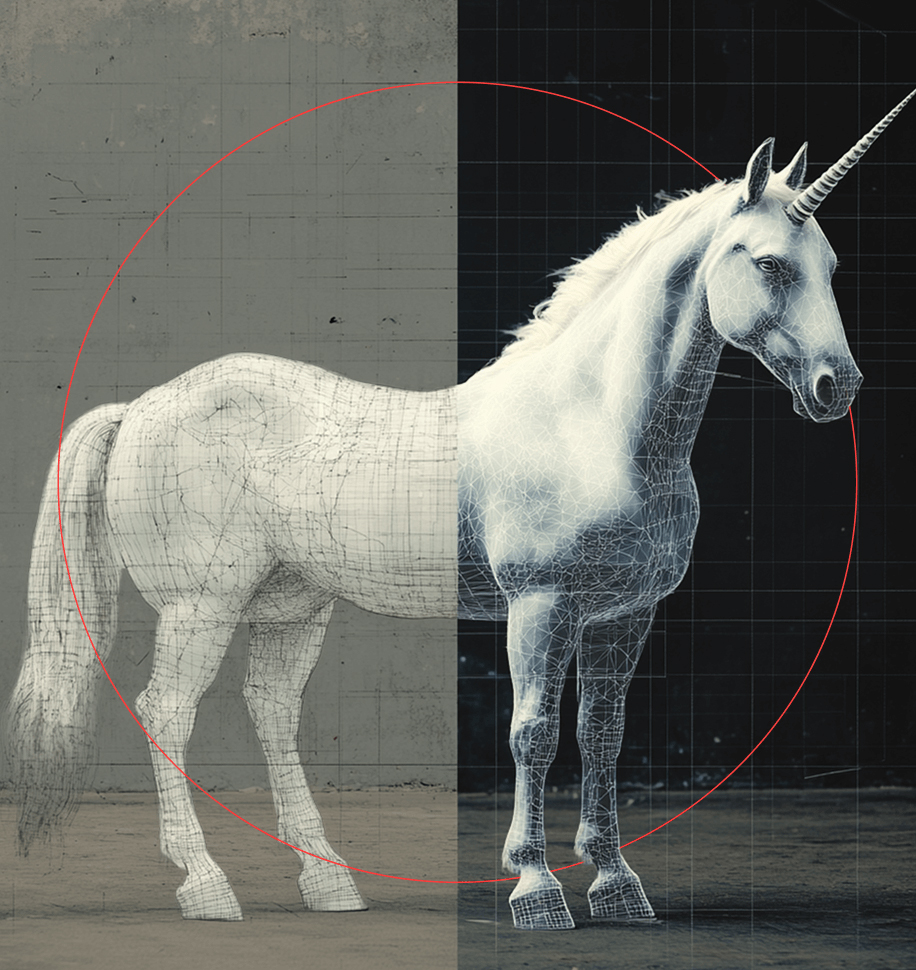
Not a mythical creature, an actual, literal unicorn. A living, breathing horse with a horn on its head. That is a thing this company can create. I know it sounds like I’ve lost my mind, so let me explain…
Josie Zayner is the most dangerous biologist on the planet. I mean that as the highest compliment. She got her Ph.D in biophysics at the University of Chicago, then went to NASA to engineer organisms for space, then founded The ODIN to put genetic engineering tools in the hands of regular people. Netflix made a documentary about her. Walter Isaacson put her in The Code Breaker. She has spent her entire career doing the thing that makes the establishment deeply uncomfortable: proving that gene editing isn’t as hard as the gatekeepers want you to think.

Now she’s editing horses.
Embryo Corporation has already produced the world’s first directly gene-edited horse embryos. They have a lab. They have a ranch. They have mares. They have a signed deal with one of the top world champion horse breeders. The DNA of 50+ elite horses is being sequenced right now.
Here’s why horses are the perfect starting point, and it’s not the unicorn thing. The global equine industry is worth $300 billion. Individual performance horses sell for $50K to $750K and up, priced almost entirely on pedigree and reputation rather than measurable genetics. Two horses with identical lineage can sell for $10K or $100K depending on the buyer’s gut feeling. It’s like buying stocks based on vibes. Meanwhile, the poultry and swine industries figured out decades ago that genomic selection makes you more money — companies like PIC and Aviagen now dominate those markets because superior genetics compound across generations. Breeding industries copy whatever wins.
Horses haven’t had their genomic revolution yet. Nobody is doing full genome sequencing in the performance horse market. Nobody is combining sequencing with predictive models with reproductive technology with gene editing under one roof. Embryo Corporation is building the entire stack. One metric governs their system: cost per embryo engineered. Every genome sequenced and every animal produced drives that number down.
The gene edits themselves are wild. MSTN knockdowns for muscle development. PDK variants for performance. TNC and COL5A1 for injury resistance — imagine a racehorse that’s genetically hardened against the injuries that end careers. Coat patterns and colors to delight your kids. People already pay premiums for a horse that looks spectacular. Because horses are non-food animals, the regulatory friction for gene editing is dramatically lower. Elite breeders aren’t waiting around — they signed on before there’s even a successful pregnancy, because the demand is already there.
Horses are the wedge. The real prize is cattle. The U.S. beef market alone exceeds $100 billion, with 87 million head still managed through pedigree catalogs and tradition. The genomic pipelines, the AI models, the gene-editing workflows — everything Embryo Corporation builds for racing horses transfers directly to feed conversion and carcass quality in beef. Nobody has a genetic or data moat in cattle. Yet.
“A fluorescent horse and maybe eventually a unicorn” has never been seen in a pitch deck before. Deep Future is proud to back the world’s first actual unicorn factory. We’ll settle for genetically superior horses while we wait.